Related news
Discover more stories about Mitacs — and the game-changing innovations driven by students and postdocs.
Innovation is no longer built in silos. At a time when technological advances are accelerating, particularly in artificial intelligence, the energy transition and cleantech, the most promising research projects are those that bring together multiple different areas of expertise. This was confirmed in discussions with Derek Newton and Quentin Hibon of Mitacs, an NFP that plays a key role in developing partnerships between universities and the Canadian private sector, with the support of the federal and provincial governments.
Mr. Newton and Mr. Hibon, respectively Senior Vice-President, Business Development and Strategic Partnerships, and Senior Advisor responsible for the energy sector within the organization, are on the same page: today’s major challenges are too complex for a single discipline.
According to Derek Newton, interdisciplinarity is a natural fit, since current issues — be they AI, public policy, energy or sustainable development — require cross-disciplinary perspectives. “We’re in the midst of a huge technological revolution,” he explains. “The pace is fast, with social, legal and economic ramifications. For Canada to remain competitive, we need teams capable of connecting these worlds,” says the VP.
“We’re in the midst of a huge technological revolution (…) with social, legal and economic ramifications. For Canada to remain competitive, we need teams capable of connecting these worlds.”
Derek Newton
This decompartmentalization enables universities to better align their research with market needs. Having been exposed to multiple disciplines, students arrive at the company with the broadly useful skills that are in demand. In this spirit, Mitacs has produced its Strategic Plan 2026-2030, which is based on expanded partnerships between the research community, companies, municipalities and public bodies.
The results are already visible: more than 35,000 innovation projects and 99,000 internships have been supported by Mitacs since 2018 across the country, including more than 13,000 innovations in Quebec.
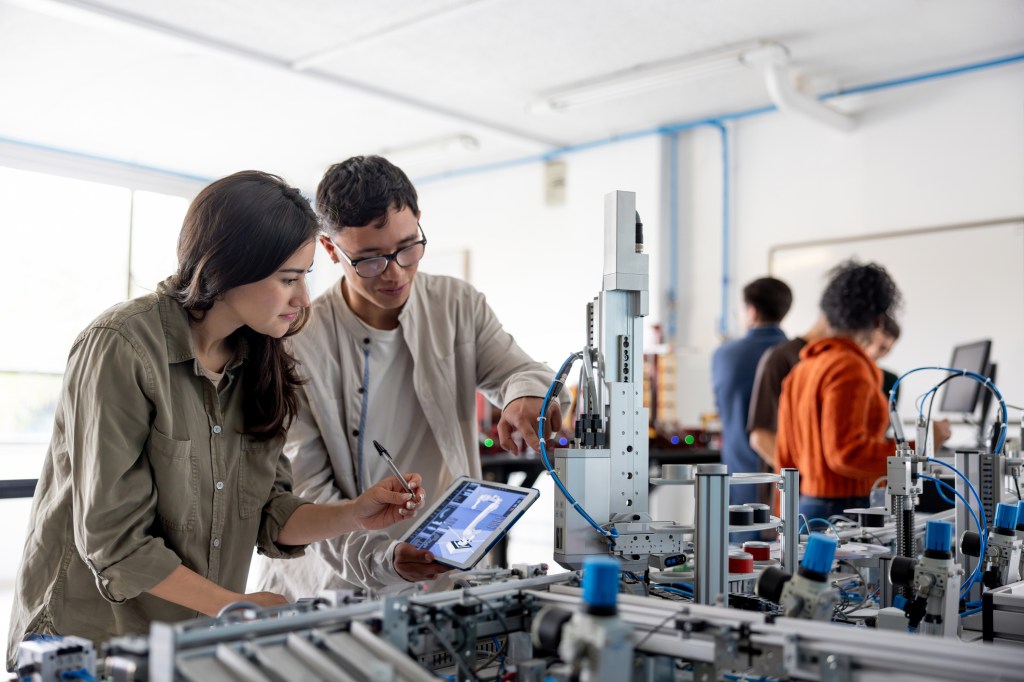
Quentin Hibon, who now manages partnerships in the vast energy sector, sees the diversity of expertise required for a single project every day. Even initially simple requests, he says, quickly become multidisciplinary. “A company that wants to integrate an AI module often already has IT teams. As soon as you add a teacher, the student, and sometimes issues such as cybersecurity, the project naturally becomes cross-disciplinary.”
He mentions a few noteworthy projects, to illustrate the need and how to meet it.
The Internet of Things (IoT) + AI + cybersecurity in the food industry: an AI-optimized sensor system for monitoring cold storage rooms required the addition of cybersecurity experts after the discovery of a critical flaw.
“[A project’s contributors] don’t always speak the same language. But this is exactly what trains students for the realities of the business world.”
Quentin Hibon
Energy transition: a project with Siemens Energy, McGill and ÉTS to optimize turbine design using AI, combining mechanical, electrical, and software engineering.
Mines 5.0: a collaboration involving Polytechnique Montréal, ÉTS and a CEGEP to automate underground mines via autonomous vehicles, 5G, sensors and predictive algorithms.
In each case, the disciplines have to work together — which isn’t always easy. Languages differ, as do realities. “Sometimes we work with an engineer, a social scientist, an AI expert… They don’t always speak the same language. But this is exactly what trains students for the realities of the business world,” explains Quentin Hibon.

Derek Newton points out that one of Mitacs’ strengths is its ability to connect players who would never have met: university departments, SMEs, large companies, municipalities, hospitals, public bodies.
On average, Mitacs partner companies see an 11% productivity gain, a 9% rise in revenues and a 16% increase in sales.
With more than 11,000 industrial partners and 198 postsecondary institutions, the organization acts as a national network capable of mobilizing talent where it’s needed most — sometimes in regions less in demand than major centres, where the response is often faster.
The benefits are measurable: 31% of interns are hired by their partner; 70% go on to R&D careers in Canada; partner companies see an average 11% productivity gain, a 9% rise in revenues and a 16% increase in sales.
Quebec is noted for its particularly well-developed culture of collaboration, strengthened by networks such as its universities, innovation zones, and the Union des municipalités du Québec. These networks facilitate large-scale projects in areas such as energy, water management, the environment and public health.
The role of the Ville de Gatineau scientific council, with which Mitacs has collaborated, is a case in point: joint projects have been launched in social sciences, risk management, mental health of first responders, and climate resilience.

Interdisciplinarity is no longer just an advantage: it’s an essential condition for accelerating innovation and ensuring Canada’s competitiveness. To both Derek Newton and Quentin Hibon, the conclusion is clear: the more disciplines collaborate, the faster research advances, and the greater the impact of the solutions that get produced.
Mitacs’s programs receive funding from multiple partners across Canada. We thank the Government of Canada, the Government of Alberta, the Government of British Columbia, Research Manitoba, the Government of New Brunswick, the Government of Newfoundland and Labrador, the Government of Nova Scotia, the Government of Ontario, Innovation PEI, the Government of Quebec, the Government of Saskatchewan, and the Government of Yukon for supporting us to empower Canadian innovation.
Do you have a business challenge that could benefit from a research solution? If so, contact Mitacs today to discuss partnership opportunities: [email protected].

Mitacs’s website content is created by people throughout our organization, united in their passion for innovation and eager to share their perspectives with others in the innovation ecosystem.
Discover more stories about Mitacs — and the game-changing innovations driven by students and postdocs.


